Why do you keep falling for the wrong type? The psychology behind it
Onedayte Redactie
Expert at Onedayte
The same dynamic again. Yet another person who is emotionally unavailable, who keeps you at a distance, who shows just enough interest to then let you down. The names change, the faces change, but the script is the same. You know it's wrong. You've been through it ten times already. But it feels like a magnet you can't resist.
That feeling of irresistibility is not coincidental. It has a psychological explanation rooted in your attachment history. And understanding that explanation is the first step towards breaking the pattern.
The attachment explanation
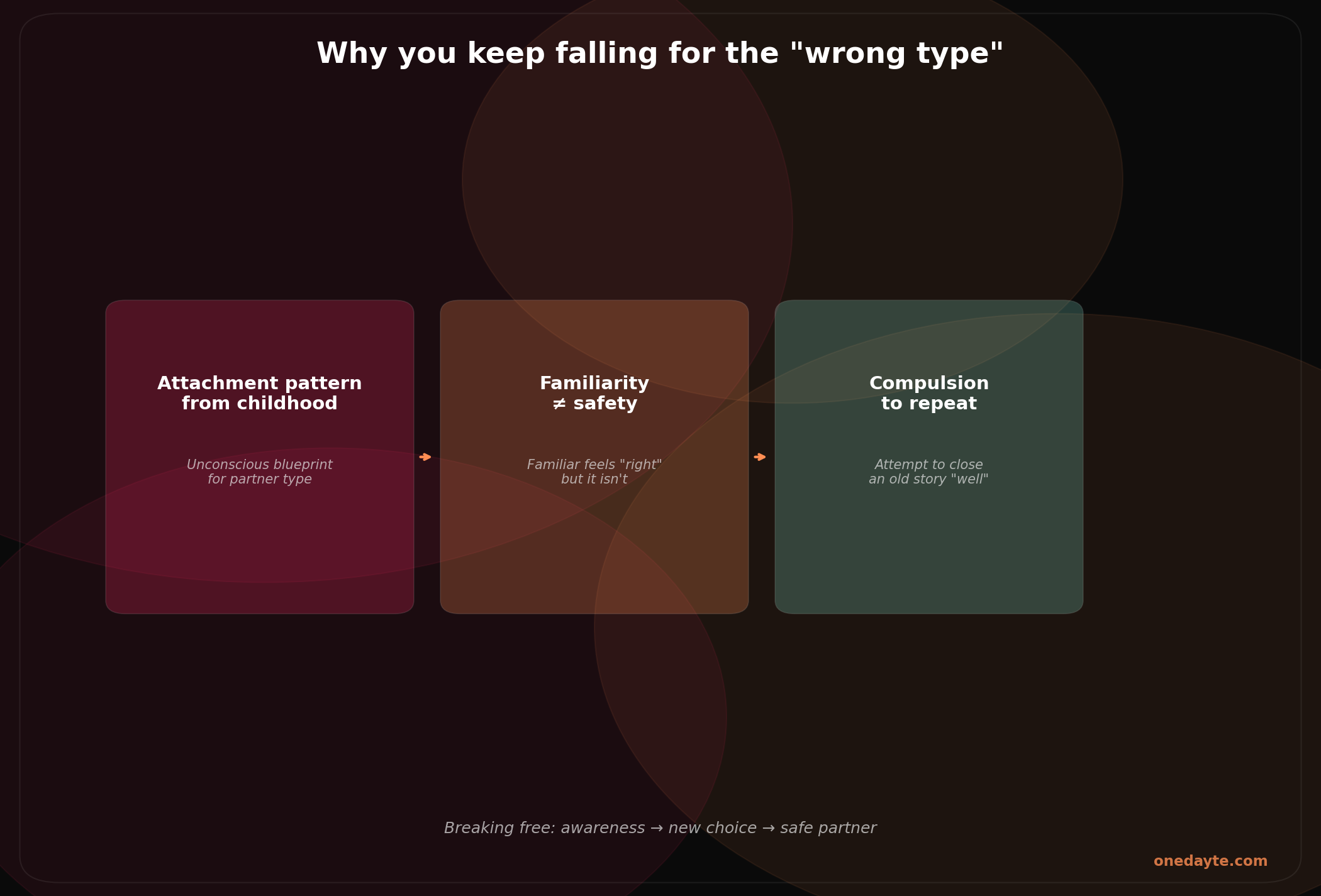
Your attachment style steers your partner choice in ways your conscious mind often doesn't see. Research by Eastwick and Finkel (2008, Journal of Personality and Social Psychology) shows that the preferences people consciously state (I want someone who is kind, I want someone who is reliable) barely predict who they are actually attracted to. Unconscious processes, rooted in your attachment style, have a much stronger influence.
Anxiously attached people feel disproportionately attracted to avoidant partners. The apparent independence feels like strength. The unavailability creates the uncertainty that activates the dopamine system. The intensity of the longing is interpreted as love. But it is not love. It is recognition. Your brain recognises a pattern from your childhood (the unpredictably available parent) and labels it as attraction.
Avoidantly attached people unconsciously choose partners who confirm their need for distance, or anxiously attached partners whose intensity initially feels exciting but soon becomes suffocating. In both cases the pattern repeats itself because it happens unconsciously.
Why the wrong type feels so attractive
Two neuropsychological mechanisms are at play. The first is intermittent reinforcement: the unpredictable reward that activates the dopamine system more strongly than a predictable reward. A partner who is sometimes available and sometimes not creates a variable reward loop that is neurologically addictive. A partner who is consistently available gives less dopamine, which is interpreted as 'less exciting', when in reality it is 'less addictive'.
The second mechanism is confusing anxiety with excitement. Research on misattribution of arousal shows that your body exhibits the same physiological response to fear and to excitement: increased heart rate, butterflies in the stomach, heightened alertness. With an unavailable partner, what you feel is partly fear of abandonment, but your brain labels it as attraction.
"Participants who experienced physiological arousal due to fear were more likely to interpret that arousal as romantic attraction."
— Dutton & Aron, Journal of Personality and Social Psychology, 1974
Breaking the type
Step one is recognition. Write down the characteristics of your last three partners. Not appearance or profession, but emotional availability, communication style and attachment behaviour. What do they have in common? What pattern do you see recurring? Those similarities point to your unconscious selection criteria.
Step two is consciously choosing differently. Give someone who isn't your type a fair chance. The absence of the familiar tension is not a sign that there is no connection. It is a sign that your nervous system isn't going into survival mode. And that is precisely what you need: a relationship that feels like safety rather than an emergency.
Step three is working on your own attachment. As long as your unconscious patterns steer you, you will make the same choices, regardless of how much you know about them. Therapy (particularly EFT or schema therapy) can help to adjust the automatic responses. A securely attached partner can function as a corrective emotional experience. And self-reflection, provided it is honest and consistent, gradually shifts the direction of your compass.
The most important insight is perhaps this: breaking your type doesn't mean settling for less. It means discovering that what you thought you wanted is not the same as what you need. And that what you need often feels surprisingly different from what you're used to.
Sources: Bowlby (1969), attachment theory, repetition compulsion