Why dating apps don't work (and what does)
Onedayte Redactie
Expert at Onedayte
You know the feeling. You open the app, scroll through an endless stream of faces, swipe right on someone who looks nice, and then: silence. Or worse, a conversation that dies after three messages. After weeks, months, sometimes years on Tinder, Bumble or Hinge you wonder whether it's you.
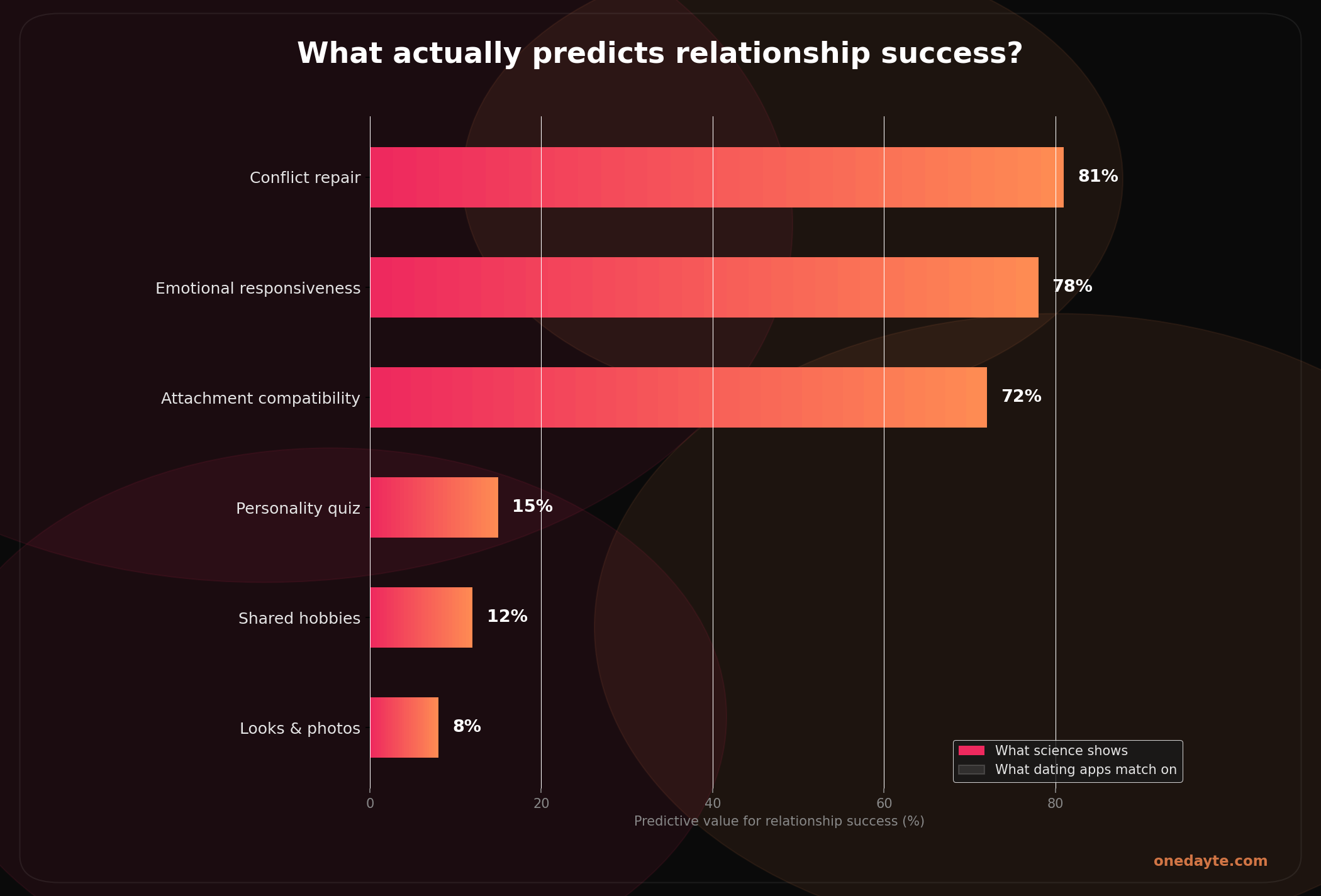
The short answer: no. It's the system. Millions of people swipe daily hoping to find someone who suits them. Yet scientific research paints a sobering picture. The factors that dating apps match on (appearance, a short bio, shared interests) have virtually no predictive value for long-term relationship success. That is not an opinion. That is what researchers from, among others, Northwestern University and Radboud University demonstrate time and again.
The problem with swiping: what the science says
In 2012, psychologist Eli Finkel published a comprehensive analysis of online dating in Psychological Science in the Public Interest. His conclusion was clear: the way dating platforms connect people is fundamentally limited. Profile information barely predicts whether two people will build a happy relationship.
"No compelling evidence supports the matching of prospective partners on the basis of similarity."
— Finkel et al., Psychological Science in the Public Interest, 2012
Five years later, a major study by Samantha Joel and colleagues's (published in Psychological Science, 2017) confirmed this picture. Using machine learning, researchers analysed data from hundreds of daters. The result: individual characteristics such as personality, preferences and values could barely predict whether two people would feel a click. What did predict whether a meeting was successful? The unique dynamic between two people. And that dynamic is precisely what a profile doesn't show.
"The variance in desire was almost entirely a property of the dyad, not a property of the individual."
— Joel et al., Psychological Science, 2017
Dopamine and the swipe loop
Swiping works as a variable reward loop. The same mechanism that makes slot machines addictive is baked into the design of Tinder and similar apps. Each swipe can yield a match, and that unpredictability gives a dopamine spike. Research from KU Leuven confirms that this setup trains your brain to judge quickly and superficially. Precisely the factors that are least predictive of a good relationship.
The result: you spend hours swiping, feel briefly excited by a match, but are left with an empty feeling afterwards. That is not personal failure. That is the app's design working as intended.
The algorithm doesn't work in your favour
Dating apps make money as long as you stay on the platform. That revenue model is at odds with helping you find a partner. Tinder's algorithm works with an ELO-like scoring system: popular profiles are shown more often, meaning a small group gets a disproportionate number of matches. For most users this means frustration, less visibility and the feeling that you're not good enough. A study highlighted by FunX confirms that most dating apps have as their primary goal getting you to take out a paid subscription, not helping you find love.
What does predict whether a relationship succeeds
If it's not appearance and shared hobbies, then what? Relationship research over the past 40 years consistently points to the same three factors.
First: attachment compatibility. Your attachment style determines how you respond to intimacy, conflict and distance. An anxiously attached person combined with an avoidantly attached person statistically produces the most unstable relationship. A good match starts with understanding each other's attachment patterns.
Second: emotional responsiveness. Research by Sue Johnson, founder of Emotionally Focused Therapy, shows that the ability to be emotionally accessible, responsive and engaged forms the core of every healthy relationship. She summarises this in the ARE model: Accessibility, Responsiveness and Engagement.
Third: conflict repair. John Gottman's research among thousands of couples shows that it is not the absence of conflict that makes a relationship successful, but the ability to move back towards each other after an argument. The so-called repair attempts are the strongest predictor of relationship stability.
"The success of a relationship depends not on whether there is conflict, but on whether repair attempts are effective."
— John Gottman, Gottman Institute Research
The solution: matching on what matters
Imagine a dating app that doesn't match on who you find attractive, but on who suits you best on the factors that scientifically matter. No endless swiping on photos, but a system that measures attachment style, conflict style and emotional responsiveness and selects matches based on that.
That is exactly what Onedayte does. Through an Attachment Scan and a conversation with an AI-powered Dating Doctor, the relational patterns that traditional apps completely miss are mapped out. The result: fewer matches, but matches that truly matter.
Sources: Finkel (2012), Joel et al. (2017), Gottman Institute