The anxious and avoidant attachment style: why they attract each other
Onedayte Redactie
Expert at Onedayte

You send a message. No reply. After two hours you send another one. After three hours you check whether the other person has been online. Meanwhile, your partner is at home feeling relieved by the silence. When you see each other again, the other person acts as if nothing is wrong. You are practically bursting with frustration.
Millions of people recognise this scenario. It is the core of the anxious-avoidant relationship dynamic: two attachment styles that attract each other like magnets, but together form a destructive cycle that exhausts both partners. According to research on adult attachment patterns, this combination occurs surprisingly often.
Why these two styles find each other
Psychologists Amir Levine and Rachel Heller describe in their book Attached how the anxiously attached person is attracted to the apparent independence of the avoidantly attached. That autonomy feels like strength, like stability. It is the opposite of their own insecurity, and therefore magnetic. Conversely, the avoidantly attached person is attracted to the warmth and emotional openness of the anxiously attached. Someone who shows feelings that the avoidant cannot access themselves.
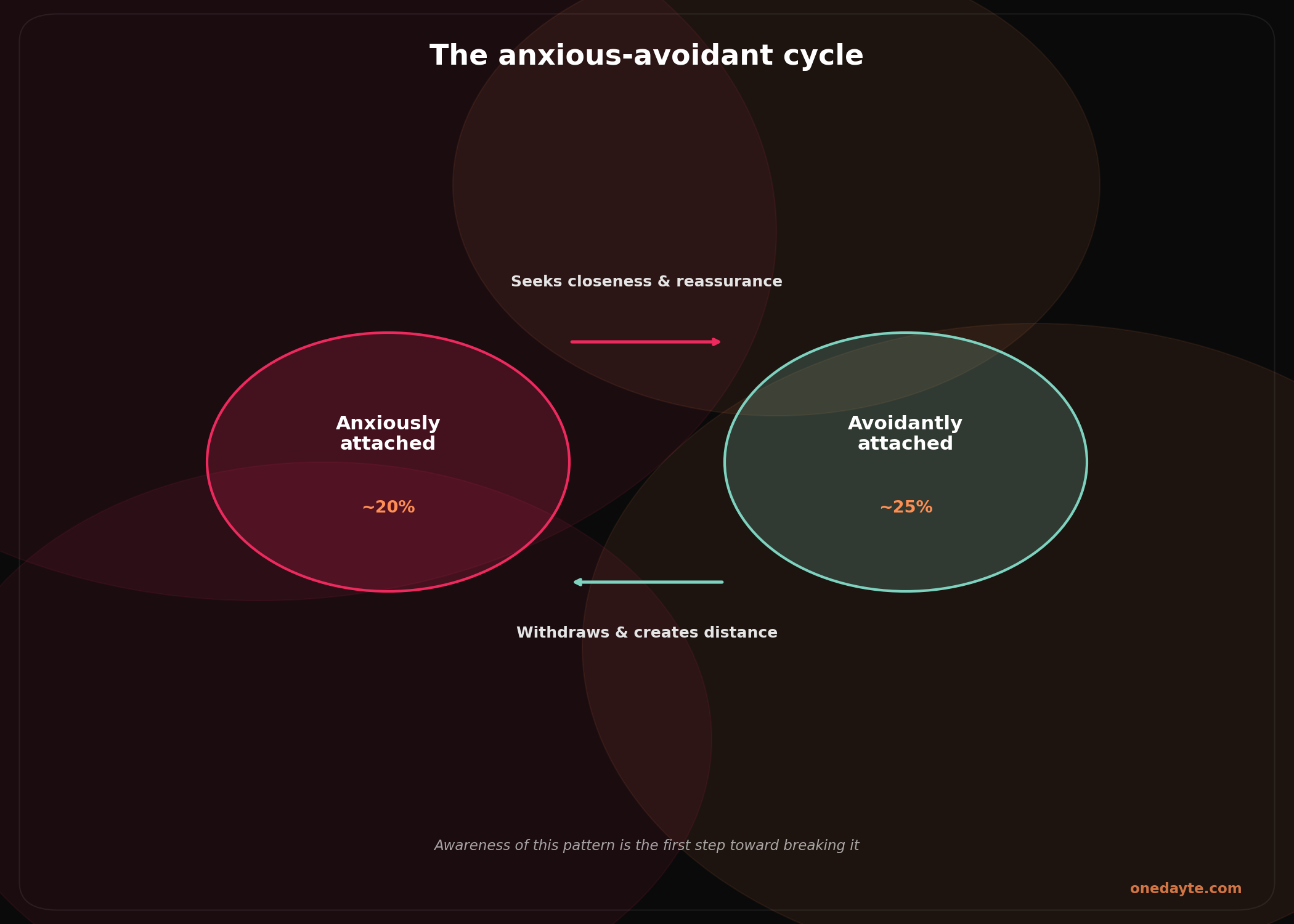
The problem is that this attraction is based on familiar patterns from childhood, not on healthy compatibility. According to research, approximately 20 per cent of adults are anxiously attached and around 25 per cent are avoidant. Those are two large groups that keep finding each other in the dating world.
The pursuer-distancer cycle
Once the relationship becomes serious, the cycle begins. The anxiously attached partner seeks reassurance and closeness. More messaging, more calling, more requests for reassurance. The more they do this, the more the avoidantly attached person withdraws. That withdrawal feels to the anxiously attached person like confirmation of their deepest fear: I am being abandoned. And so they pursue even harder.
Relationship therapists call this the pursuer-distancer dynamic. The anxiously attached pursues: confronting, people-pleasing, analysing. The avoidantly attached flees: silence, distance, shutting down emotionally. Each round reinforces the pattern. The pursuer becomes more demanding. The distancer withdraws further.
Sue Johnson, founder of Emotionally Focused Therapy (EFT), calls this the negative interaction cycle. An important insight from her work: it is not one partner who is the problem. It is the dance between both that undermines the relationship. Both partners are trapped in a pattern that hurts them both.
"Are you there for me? Can I count on you? Will you respond to me when I need you?"
— Sue Johnson, Hold Me Tight, 2008
Why it feels like real love
The intensity of the push-pull dynamic is often confused with passion. After a period of distance comes a reunion, and that reunion produces an enormous dopamine spike. It feels like relief, like renewed love. But it is what psychologists call intermittent reinforcement: the same mechanism that sustains gambling addiction. The unpredictability of the reward is precisely what makes the pattern addictive.
Real love does not feel like a rollercoaster. Real love feels like a safe haven. That is the distinction that recurs in virtually every study on healthy relationships: safety, not intensity, is the foundation of lasting happiness.
How do you break the pattern?
The first step is recognition. Know which attachment style you have. A reliable method is the ECR-R (Experiences in Close Relationships - Revised), developed by the Fraley Lab. It measures your position on two dimensions: anxiety about abandonment and discomfort with intimacy.
The second step is choosing consciously. Research from Psyned and the broader attachment literature shows that the most stable relationships arise when at least one of the two partners is securely attached. Consciously choose someone who is available, responsive and consistent. Even if that feels less exciting at first than the familiar rollercoaster.
The third step is working on earned security. Your attachment style is not set in stone. Longitudinal research shows that approximately 25 per cent of people change their attachment style over the course of their lives. Sometimes through a secure partner, sometimes through targeted therapy, sometimes through a life event that provides perspective.
How Onedayte prevents this mismatch
Onedayte measures the anxiety and avoidance scores of each user in the Attachment Scan through 12 scenario questions. Not abstract scale questions ('I feel uncomfortable with intimacy: 1 to 5'), but concrete situations that reveal actual behaviour. Pairs whose scores indicate a high risk of the anxious-avoidant trap are not shown to each other, unless one of the two partners shows clear signs of secure attachment.
That is a deliberate and ethical choice. The research is clear: matching two people who have a high chance of a destructive cycle is not in anyone's interest. Better fewer matches, but matches that offer a real chance of happiness.
Sources: Bowlby (1969), Hazan & Shaver (1987), Fraley Lab