Self-knowledge and better relationships: why self-insight is the key
Onedayte Redactie
Expert at Onedayte

You've had enough dates by now to recognise a pattern. The same kind of partners, the same kind of problems, the same kind of ending. The names change, the faces change, but the dynamic remains surprisingly consistent. And you wonder: is it me?
The answer is nuanced. It's not you as a person. But it is patterns that you unconsciously repeat. And those patterns can be changed once you see them. That is the promise of self-knowledge: not that you become perfect, but that you choose more consciously.
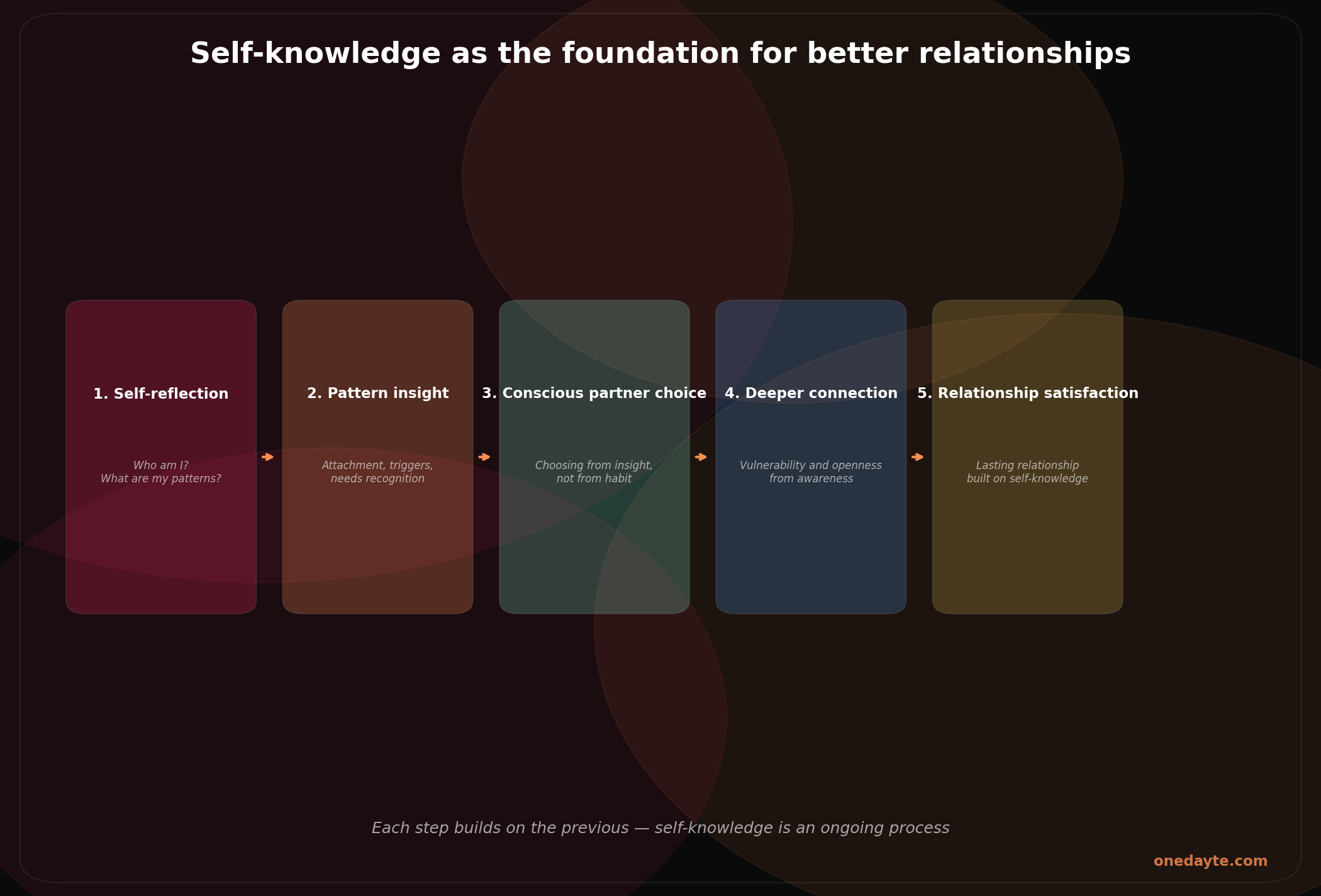
Why we repeat patterns
Research by Simine Vazire (2010, published in Psychological Review) shows that people are surprisingly poor at assessing their own personality. Especially on dimensions that are socially sensitive, such as how dominant, how emotional or how creative you are, there is a significant gap between self-perception and how others experience you.
In relationships this manifests as blind spots. You think you communicate openly, but your partner experiences you as closed off. You think you give space, but your partner feels neglected. You think you're not clingy, but your matches experience you as overwhelming. That discrepancy between self-image and actual behaviour steers your partner choice and your relationship behaviour in ways you don't see yourself.
"Self-knowledge has significant blind spots. People are often unaware of how they come across to others, especially on traits that are highly evaluative."
— Vazire, Journal of Personality and Social Psychology, 2010
That is precisely why the pattern repeats. You choose partners based on unconscious criteria (which are often rooted in your attachment style), you exhibit behaviour whose impact you underestimate, and you interpret the other person's reactions through the lens of your own blind spots. The result: the same dynamic, different names.
The four areas of self-knowledge that matter
The first area is your attachment style. How do you respond to intimacy? What do you do when your partner pulls away? What do you feel when someone wants to get close? Your attachment style is the foundation of your relational behaviour, and understanding it is the most impactful step towards better relationships.
The second is your values. Not what you think you should find important, but what you truly find important. Look at your behaviour, not your beliefs. What do you spend your time and money on? What makes you emotional? Those answers reveal your true values.
The third is your communication style. How do you convey your needs? Do you use I-statements or you-accusations? Do you respond to criticism with defensiveness or openness? Many communication problems in relationships are not an intention problem but a skill problem.
The fourth is your dealbreakers. What are your non-negotiable boundaries? Not the list on your dating profile, but the actual boundaries you maintain in practice. Research by Jonason et al. (2015) shows that dealbreakers have a stronger effect on partner choice than positive qualities, but that many people have not clearly articulated their own dealbreakers.
"Dealbreakers had a stronger effect on desirability judgments than dealmakers."
— Jonason et al., Personality and Social Psychology Bulletin, 2015
How Onedayte facilitates self-knowledge
The Attachment Scan, the Doctor Conversation and the Match Boosters are all three designed to give users self-insight. The Attachment Scan shows you where you stand on the dimensions of anxiety and avoidance. The Doctor Conversation holds up a mirror to how you respond to emotional situations. The Match Boosters (including the friend reference, where a friend answers 5 questions about you) correct the blind spots that you cannot see in yourself.
The goal is not to judge you, but to help you recognise patterns. Because those who know their patterns can change them. And those who change them choose better partners.
A particularly powerful instrument for this is the friend reference that Onedayte offers as a Match Booster. A good friend answers five short questions about you. How would you describe your friend's communication style? What is their greatest strength in relationships? What should a partner know? That external perspective corrects the blind spots that everyone has about themselves. Research by Vazire (2010) confirms that external assessors estimate personality on certain dimensions more accurately than self-reporting.
That external correction is one of the most powerful instruments for breaking dating patterns that you cannot see on your own.
Sources: Aron & Aron (1997), Mikulincer & Shaver (2007)