Dealbreakers in a relationship: what does the science say?
Onedayte Redactie
Expert at Onedayte

You can get along fantastically with someone. The conversation clicks, there's attraction, the values align. But if that person smokes and that's non-negotiable for you, it stops there. No positive trait outweighs a fundamental incompatibility. That is the power of dealbreakers: they are absolute.
But how exactly do dealbreakers work? Which ones are universal and which are personal? And is it possible that your dealbreakers unnecessarily limit your chances?
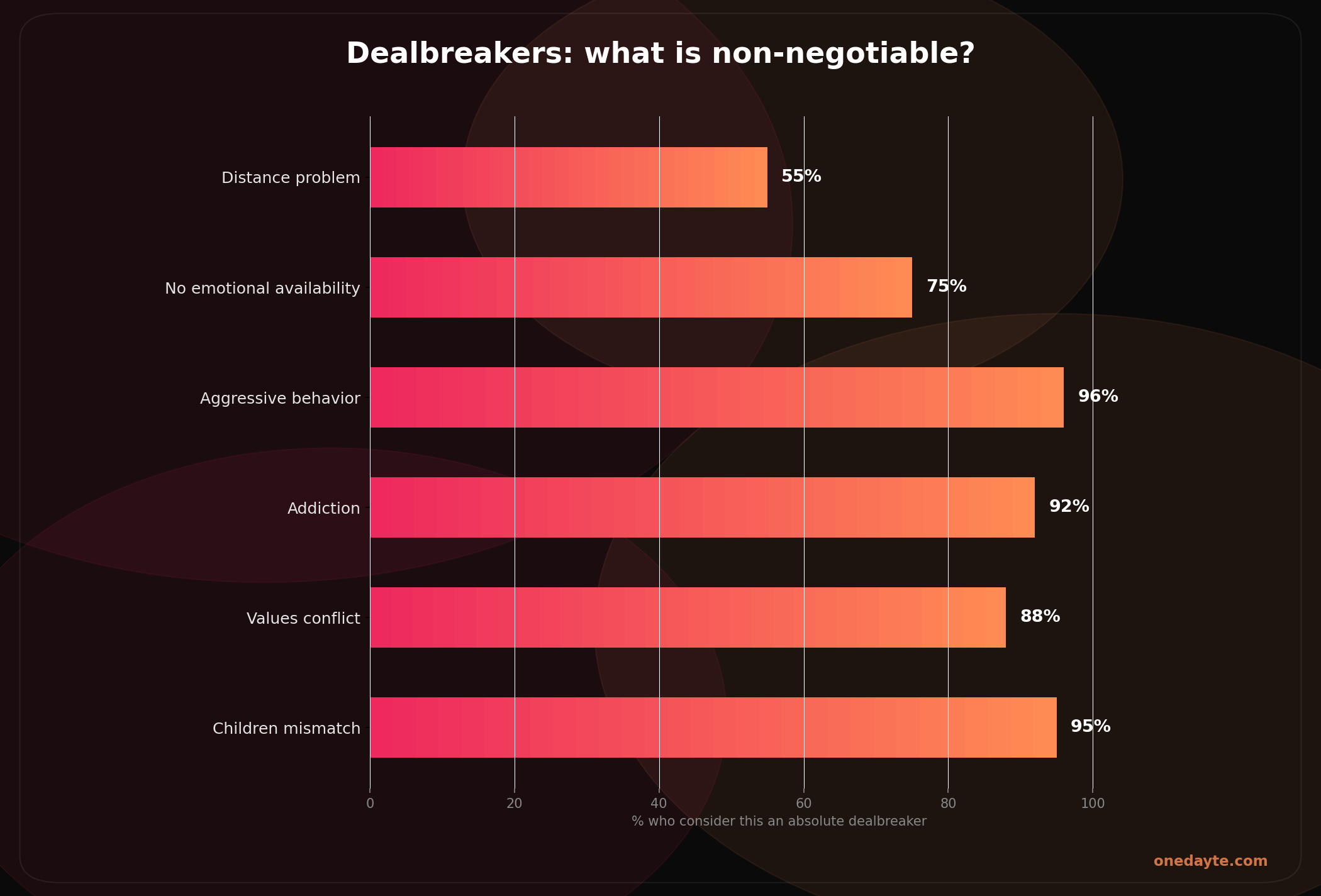
Dealbreakers weigh heavier than dealmakers
Research by Jonason, Garcia and Webster (2015), published in the Personality and Social Psychology Bulletin, yielded a surprisingly clear insight: dealbreakers have a stronger effect on partner choice than dealmakers. A positive trait (funny, ambitious, intelligent) makes someone more attractive, but a dealbreaker makes someone unattractive, regardless of how many positive traits offset it.
"Dealbreakers had a stronger effect on desirability judgments than dealmakers."
— Jonason et al., Personality and Social Psychology Bulletin, 2015
Psychologists explain this with loss aversion, the principle from behavioural economics that losses weigh heavier than gains. We are more motivated to avoid disadvantages than to obtain advantages. In dating, this translates to a strong focus on what we don't want, often stronger than the focus on what we do want.
"People are more sensitive to negative information about potential partners than to positive information."
— Jonason et al., 2015
The implication for matching is fundamental. An algorithm that only matches on positive similarities (shared hobbies, personality type) misses the point if it ignores dealbreakers. A match with 95 percent overlap on fun things but a fundamental mismatch on a dealbreaker is not a good match.
The most common dealbreakers
Jonason's research identified the dealbreakers most frequently mentioned. An unhealthy or unkempt appearance ranks high on the list, not as superficiality but as a signal of self-care. Smoking is one of the most universal dealbreakers. Lack of ambition or motivation. A mismatch in desire for children (one wants children, the other doesn't) is almost always insurmountable. Different religious or philosophical convictions, depending on the intensity with which someone lives them. Lack of humour or, more specifically, an incompatible sense of humour. And long physical distance.
What stands out is that the strongest dealbreakers are not about preferences but about fundamental life design. Smoking is a daily habit that doesn't change. Desire for children is an existential choice. Religious conviction touches the core of someone's value system. These are not the things that irritate you but the things that steer your life in a different direction than you want.
Equally important: dealbreakers are personal. What is non-negotiable for one person is irrelevant for another. Someone who smokes doesn't have smoking as a dealbreaker. Someone who isn't religious may not have religious difference as a dealbreaker. The universality lies in the mechanism (dealbreakers weigh heavier than dealmakers), not in the content.
How Onedayte handles dealbreakers
In Onedayte's three-layer matching system, Layer 1 is the dealbreaker filter. It is binary: if a hard dealbreaker is triggered (desire for children mismatch, smoking, religious difference above a certain threshold, distance greater than the specified maximum), the pair does not proceed to Layer 2. Regardless of how high the potential compatibility on other dimensions might be.
That approach is deliberately rigid. There is no point in matching two people who fit perfectly on all emotional dimensions but fundamentally clash on a dealbreaker. Those collision points don't resolve through a good conversation. They are structural.
The alternative — hoping that a dealbreaker will disappear on its own or become less important — is a strategy that rarely works and often leads to years of frustration that erodes the relationship from within.
When to question your dealbreakers
Not all dealbreakers are equal. Some are rooted in genuine values (desire for children, lifestyle). Others are rooted in prejudices or limited experience. 'No tattoos' may not be a value but an aesthetic preference. 'Must be taller than me' may not be a fundamental criterion but a societal norm you've unconsciously adopted.
A healthy exercise is to test your dealbreakers against two questions. Firstly: is this based on a genuine value or on an assumption? Secondly: have I ever rejected someone based on this criterion who in hindsight might have been a good match? If the answer to the second question is yes, the criterion deserves reconsideration.