Falling in love and attraction: what science really says
Onedayte Redactie
Expert at Onedayte

Falling in love feels like magic. Your heart skips a beat, your thoughts revolve in circles around that one person, the world seems more beautiful and more intense. It feels as if fate has brought you together, as if there is a cosmic force at play that is greater than yourself.
But behind that magic lies biology. Psychology. Evolution. And understanding how attraction actually works does not help you to dismantle the magic, but to make better choices. Because falling in love and compatibility are two different things. And confusing them is one of the most common mistakes in one's love life.
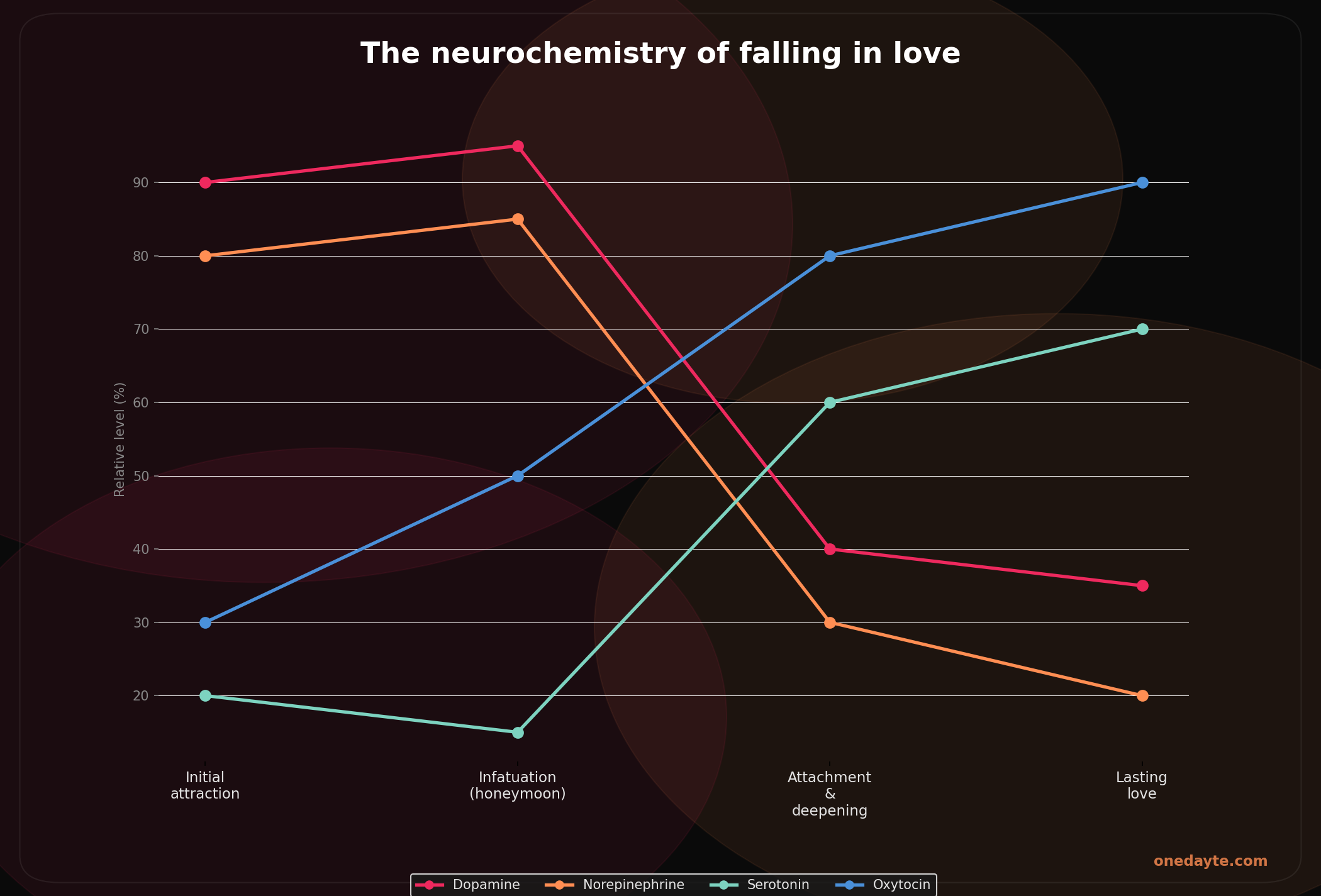
The neurochemistry of falling in love
Anthropologist Helen Fisher of Rutgers University has demonstrated through brain scans that falling in love activates a specific neurological pattern. The ventral tegmental area (VTA) pumps dopamine to the reward system, which produces the motivation and desire that characterise falling in love. Norepinephrine rises, providing alertness and euphoria. And serotonin drops, which explains why you think obsessively about the other person — comparable to the brain chemistry seen in obsessive-compulsive disorders.
It is comparable to an addiction, and that is precisely why it feels so intense. Your brain has literally changed chemically. Every time you see the other person or receive a message, the reward system is activated. Every time the other person is unreachable, it feels like withdrawal. This also explains why the end of being in love can feel physically painful: your brain goes through a kind of withdrawal symptoms.
Important: this neurochemical cocktail lasts on average 12 to 18 months. After that, the relationship shifts to a phase of attachment, driven by oxytocin and vasopressin. These are calmer hormones that create a sense of bonding and safety. Less exciting than the dopamine explosion of falling in love, but more stable and deeper.
Attraction versus compatibility
Here lies the core of the problem for daters. Initial attraction and long-term compatibility are determined by fundamentally different factors. You can be intensely attracted to someone who is a poor match for you (because the halo effect clouds your judgement, or because insecure attachment patterns amplify the intensity). And you can barely be attracted to someone who is a perfect match (because there is no dopamine spike when there is no uncertainty).
Research by Eastwick and Finkel (2008), published in the Journal of Personality and Social Psychology, confirms this discrepancy. In speed-dating experiments, the preferences people stated in advance (I want someone who is funny, I want someone who is ambitious) barely predicted who they were actually attracted to. The conscious image you have of your ideal partner rarely matches who makes your heart beat faster.
That is not tragic. It is information. It means you should not ignore the feeling, but you should not blindly follow it either. Attraction is a starting point, not a destination.
Moreover, attraction is not static. What you find attractive changes through experiences, through growth, through understanding your own patterns. Someone who at twenty was only attracted to appearance may at thirty be far more sensitive to emotional warmth and humour. That shift is a sign of growth, not of lowering standards. It means your brain has learned to look beyond the surface.
This makes it all the more important not to judge too quickly. Give a match the chance to become more attractive as you get to know them better.
What this means for dating
Zajonc's mere exposure effect (1968) offers a more nuanced view of attraction. Familiarity increases attractiveness. The more often you see or speak to someone, the more attractive you find that person — even if the initial attraction was barely or not there at all. Many happy couples confirm this: they did not necessarily find their partner attractive at the first meeting, but as they got to know each other, the attraction grew.
That is the principle behind Onedayte's Progressive Reveal. By first getting to know the personality through conversation, and only then revealing the photos, the mere exposure effect is given the chance to work. The result is that attraction is not solely based on visual impression, but enriched by emotional connection.
"The message of EFT is simple: Forget about learning to argue better. Instead, recognize that you are deeply attached to your partner and that you need emotional connection."
— Sue Johnson, Hold Me Tight, 2008
Sources: Fisher (2004), Bartels & Zeki (2000)