The science behind matching: what predicts relationship success?
Onedayte Redactie
Expert at Onedayte
Can an algorithm predict whether two people will be happy together? The honest answer is: it depends on what you measure.
In 2017, Samantha Joel and colleagues published a groundbreaking study in Psychological Science. They used machine learning to predict which speed-daters would feel a click. The result was startling: individual characteristics (personality, preferences, values, demographic data) could explain only 1 per cent of the variation in romantic attraction. The remaining 99 per cent lay in the unique dynamic between two people. It is not who you are as an individual that determines the success of a relationship, but how you function together.
"Romantic chemistry is fundamentally unpredictable from individual characteristics alone."
— Joel et al., Psychological Science, 2017
What Eli Finkel discovered about online dating
Psychologist Eli Finkel of Northwestern University analysed the complete landscape of online dating research in 2012. His conclusion, published in Psychological Science in the Public Interest, was devastating for the dating industry: the matching algorithms of existing platforms are not scientifically supported. They measure the wrong things.
"The matching algorithms that these sites use are not likely to be any more effective than the alternatives that they have replaced."
— Finkel et al., Psychological Science in the Public Interest, 2012
Where platforms like Parship match on personality types (Big Five), the research shows that personality similarity in itself barely predicts whether two people will be happy. Two extraverted people are not automatically a good match. Neither are two conscientious people. What does predict it: how two people function together. How they respond to each other's emotions. How they deal with conflict. Whether they turn towards each other or away.
"The most important thing is to turn towards each other's emotional needs."
— John Gottman, Gottman Institute
Finkel's conclusion was not that online dating is pointless. His point was that the enormous potential of technology is being wasted by measuring the wrong factors. If you are able to measure the dynamic between two people before they meet, you have a tool that is more powerful than any traditional matchmaker.
The three layers of matching
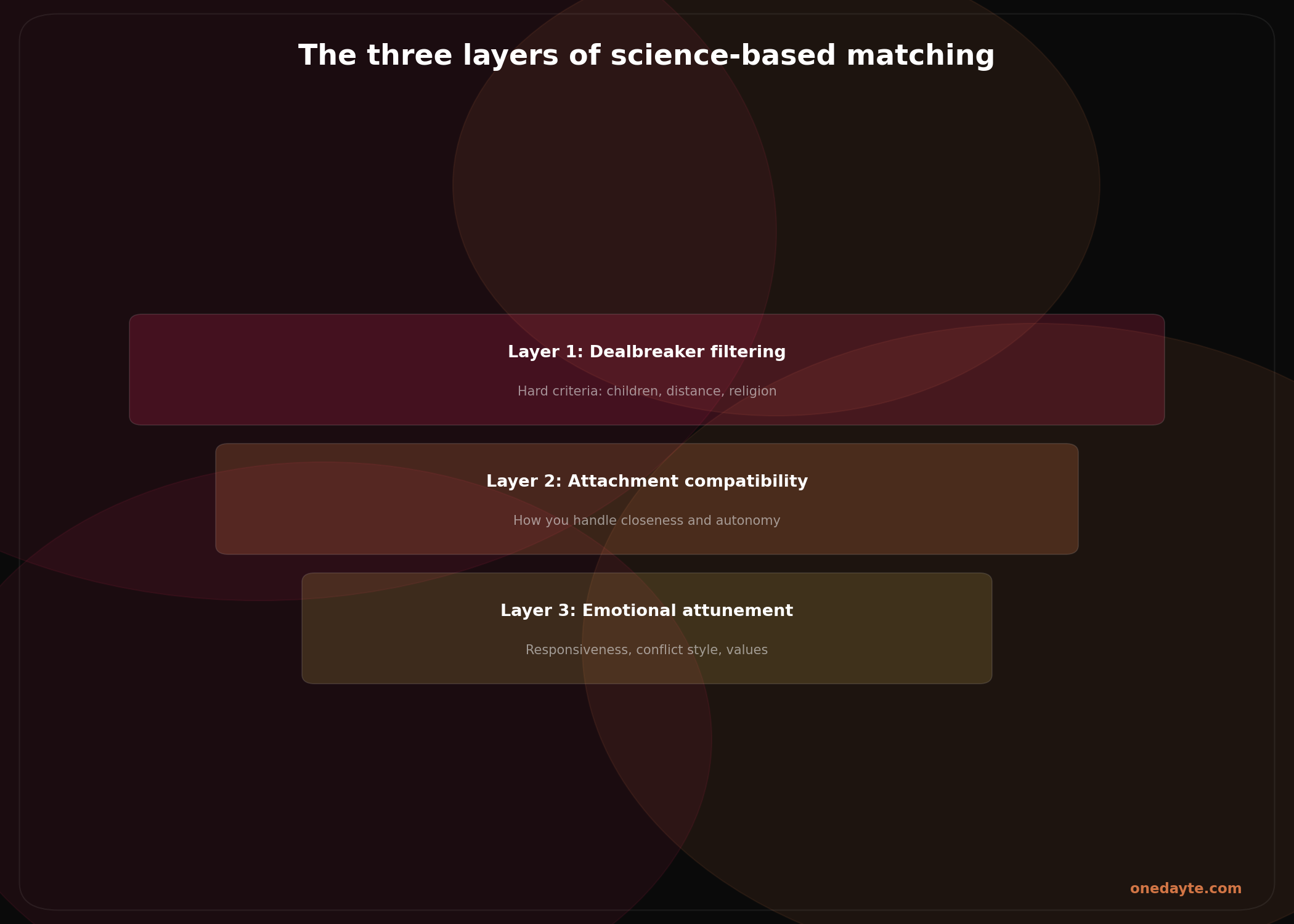
Based on this research, Onedayte has developed a three-layer matching system that filters step by step, from coarse to fine.
Layer 1 is the dealbreaker filter. Binary, no nuance. Smoking, desire for children, religion, maximum distance. If a hard dealbreaker is triggered, the pair does not proceed to layer 2, regardless of how high the potential compatibility on other dimensions might be. This prevents you from investing time in someone with whom a fundamental mismatch exists.
Layer 2 is attachment compatibility. The Attachment Scan measures anxiety (fear of abandonment) and avoidance (discomfort with intimacy) on continuous scales via 12 scenario questions. Pairs with a compatibility score below 0.30 are not shown. The most high-risk combination, anxious combined with avoidant, is filtered out unless one of the two partners exhibits sufficient secure characteristics. This is the gate that prevents the most destructive mismatches.
Layer 3 is the weighted compatibility score. This is where all dimensions measured by the Doctor Conversation and the Match Boosters come together: emotional responsiveness (22 per cent of the score), conflict style with Four Horsemen detection (18 per cent), shared values (15 per cent), fondness and admiration capacity (12 per cent), repair ability (10 per cent), and several additional dimensions. The end result is a score from 10 to 99 per cent that determines which matches are shown and in what order.
Why Onedayte matches differently
The difference from other dating apps is not that Onedayte has a smarter algorithm. The difference is that Onedayte collects different data. Through the Attachment Scan (12 scenario questions) and a conversation with an AI-powered Dating Doctor (12 to 15 messages), dimensions are measured that no profile can capture.
The Dating Doctor is not a questionnaire. It is a conversation that progresses from safe to vulnerable, based on principles of Emotionally Focused Therapy. It analyses not only what you say, but how you say it. Are you defensive when probed about conflict? Do you withdraw at emotional questions? Or do you respond openly and reflectively? Those nuances are the data points that make the difference.