Red flags in dating: recognise them before it's too late
Onedayte Redactie
Expert at Onedayte

In the beginning, everything is perfect. The compliments flow, the attention is overwhelming, and you feel like the centre of someone's world. But somewhere something gnaws at you. A feeling that it's moving too fast, too intense, too good to be true. That feeling is not paranoia. It is your intuition flagging a red flag.
"People are more sensitive to negative information about potential partners than to positive information."
— Jonason et al., Personality and Social Psychology Bulletin, 2015
Red flags are the early warning signs that your mind notices but your heart ignores. They are not always loud and clear. Sometimes they are subtle, even charming. And that is precisely what makes them so dangerous.
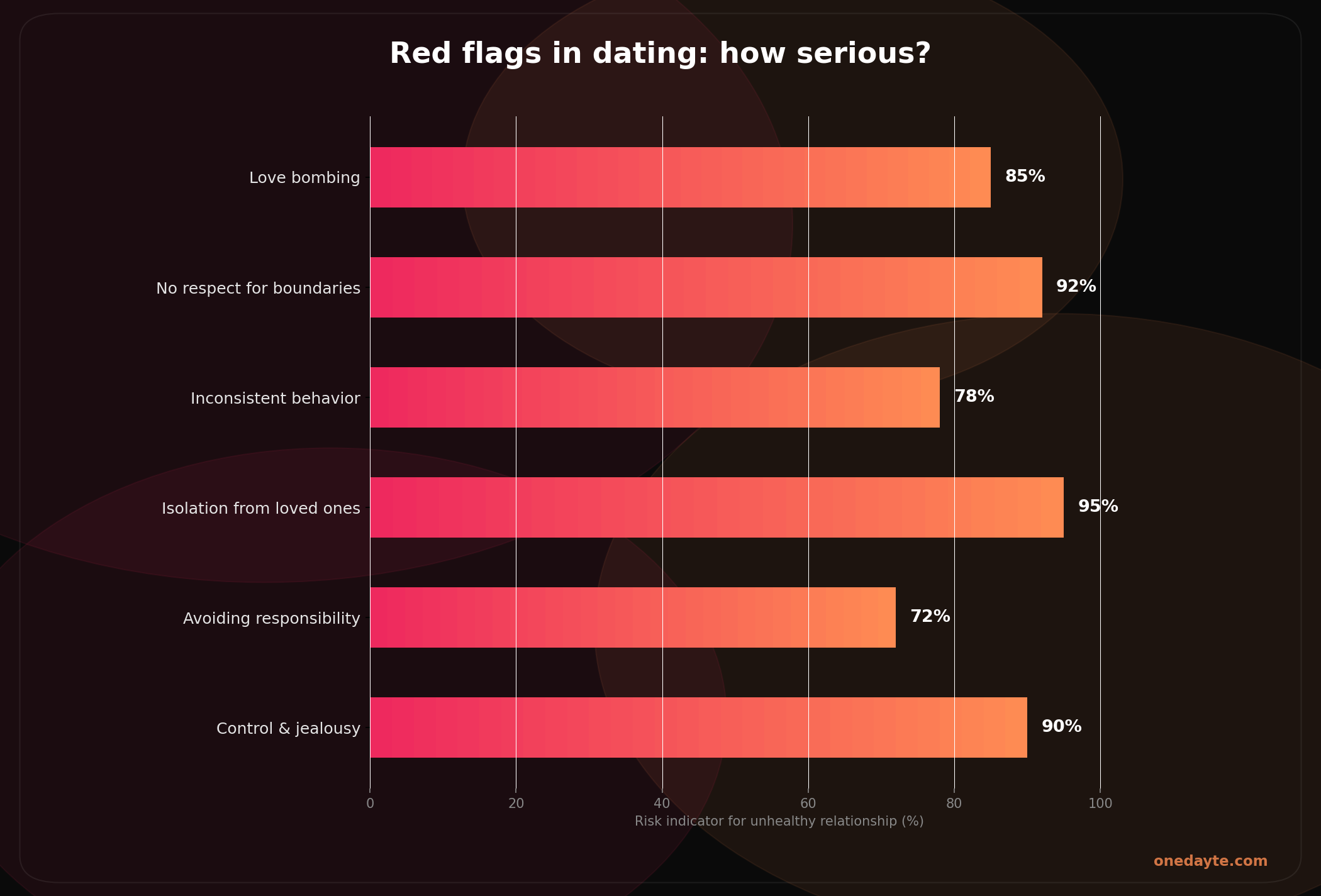
Love bombing: too much, too fast
Love bombing is a pattern in which someone floods you with attention, compliments and grand gestures at the start of a relationship. Daily lengthy messages, extravagant gifts after the second date, talking about a shared future after two weeks. It feels flattering and exciting. But it serves a purpose: making you emotionally dependent before you truly know the person.
The difference from genuine interest is the pace and the reciprocity. Genuine interest respects your pace. Love bombing pushes through, regardless of how you feel about it. If you have the feeling that you are running behind the facts in your own relationship, that the other person is moving faster than you are comfortable with, that is a signal that the pace is not coming from you.
Research on love bombing shows that it often goes hand in hand with narcissistic behaviour or an insecure attachment style in the giver. Not always consciously manipulative, but structurally problematic. The intensity with which someone floods you in the beginning is rarely sustainable, and the crash that follows when the idealisation fades can be all the more painful.
Breadcrumbing, benching and orbiting
Breadcrumbing is giving just enough attention to keep you interested, without any real intention of more. A message here, a like on Instagram there, but never a concrete date. It keeps you in a state of hope that is constantly fed but never fulfilled.
Benching is similar: you are put on the reserve bench while the other person explores other options. You have not been rejected, but you have not been chosen either. You are kept available just in case.
Orbiting is the phenomenon where someone who has ghosted or rejected you continues to follow your social media, watches your stories, likes your posts. No contact, but no complete absence either. It keeps the door ajar — a door that never opens.
These patterns have in common that they create ambiguity. And ambiguity is the breeding ground for insecurity, rumination and declining self-confidence. They are not always consciously manipulative — sometimes they result from someone's inability to communicate honestly — but the effect is the same.
A red flag specifically associated with online dating is the phenomenon of presenting multiple versions of oneself. Someone who has a completely different profile on Hinge than on Bumble, or who gives contradictory information in conversations about work, age or relationship history, shows a pattern of inconsistency that deserves further attention. It does not have to be deliberate deception — sometimes it is insecurity about one's own identity — but it is a signal that openness and honesty are not self-evident.
The red flags you must not ignore
Inconsistency between words and actions. Someone who says they are interested but keeps cancelling dates. Pressure to accelerate the pace. Demanding exclusivity after two dates, suggesting moving in together after a month. Lack of respect for your boundaries. You do not feel heard when you say something is moving too fast or going too far. Speaking negatively about all exes. If every previous partner was 'crazy' or 'toxic', the common denominator is not the exes. Structurally avoiding answering direct questions. Evasive responses to 'What are you looking for?' or 'Where is this going?' Disguising control as concern. 'I worry when you don't reply straight away' sounds sweet, but it can be control.
Source: clinical psychological research on abuse indicators