Tired of online dating? How to recognise and break through dating burnout
Onedayte Redactie
Expert at Onedayte

Another match. Another 'hey, how are you?'. Another conversation that dies after three messages. You open the app, scroll for a bit, and close it again. Not because there's nobody there, but because you can no longer muster the energy. The thought of yet another first date feels like a chore instead of an adventure.
If this sounds familiar, you're probably dealing with dating burnout. You're far from alone. According to the Dating Burnout Report by Hinge (2023), more than half of active dating app users regularly experience feelings of emotional exhaustion. And research from the University of Rotterdam confirms that prolonged use of dating apps is associated with a more negative self-image and increasing feelings of loneliness.
What is dating burnout?
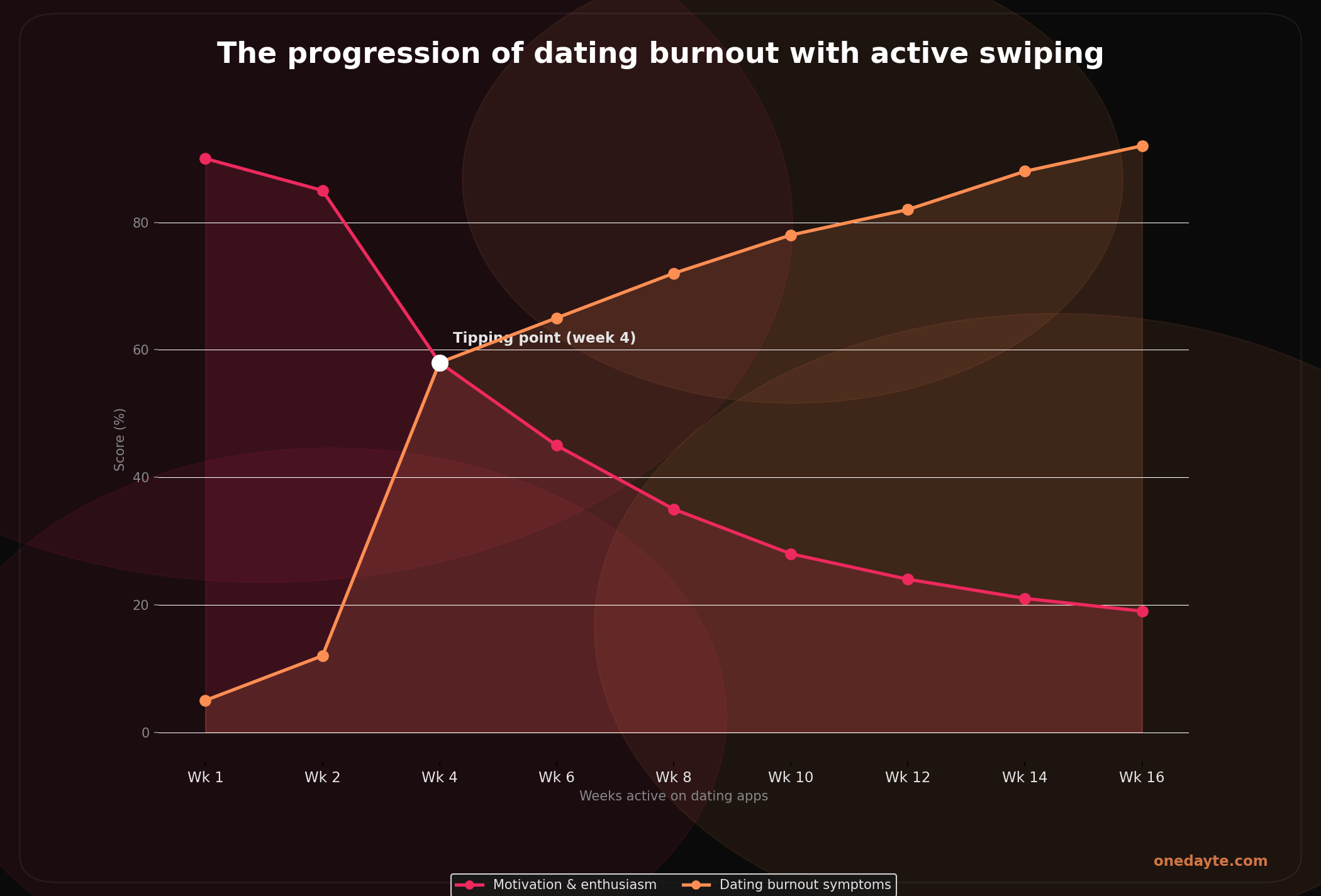
Dating burnout is the emotional exhaustion that arises from prolonged use of dating apps without satisfying results. It has three core symptoms. First: you feel emotionally drained after opening the app, as if every interaction costs energy instead of giving it. Second: you become cynical about the intentions of other daters, assuming that everyone is non-committal or lying. Third: your self-confidence drops through repeated disappointment, and you start wondering if it's your fault.
The difference from simply not being in the mood is the intensity and duration. With dating burnout, it's a structural pattern that affects your energy, motivation, and self-image. It's not limited to the app: it influences how you view dating and relationships in general.
Why dating apps cause burnout
Three psychological mechanisms are at play that together form a toxic cocktail.
The first is choice overload. Psychologist Barry Schwartz described in his work how too many options lead to decision paralysis and dissatisfaction. On a dating app with thousands of profiles, every choice becomes harder. You keep swiping because there could always be someone better, yet you're never satisfied with what you find.
"Learning to choose is hard. Learning to choose well is harder. And learning to choose well in a world of unlimited possibilities is harder still."
— Barry Schwartz, The Paradox of Choice, 2004
The second mechanism is dopamine depletion. The swipe model activates your brain's reward system through unpredictable rewards — the same mechanism as gambling. At first, it feels exciting. After weeks or months, the system becomes exhausted. The same activity that once gave a thrill now feels like an empty action.
The third is rejection fatigue. Every unanswered match, every conversation that fizzles out, every date that leads nowhere: it all accumulates. Research on rejection sensitivity (Downey and Feldman, 1996, published in the Journal of Personality and Social Psychology) shows that repeated social rejection lowers the threshold for pain. You become more sensitive to rejection, not less. And dating apps serve rejection at a pace that would be unthinkable in the offline world.
5 signs you have dating burnout
You open the app and close it within a minute, without doing anything. You no longer feel anything with a new match: no excitement, no curiosity. You unconsciously compare everyone to an ex or to an idealised image that doesn't exist. You've become cynical about other daters' intentions and assume that everyone is lying or not serious. You avoid conversations about your love life with friends because you're tired of the subject.
How do you get out of dating burnout?
Take a deliberate break. That sounds simple, but it requires discipline. Delete the apps for at least two weeks — no exceptions. Research shows that a complete reset is more effective than 'swiping less'. Use that time not to think about dating, but to invest in the other things that give you energy: friends, sports, a project.
Then redefine your criteria. Not based on photos or bios, but on what scientifically predicts whether a relationship succeeds: attachment style, shared values, emotional availability. Write down for yourself what you truly need in a partner. Not what you find attractive, but what you need.
Finally, consider a platform that facilitates depth instead of volume. Fewer matches that truly suit you yield more energy than hundreds of superficial options that make you feel like you're in a supermarket where nothing appeals to you.
Sources: Hinge (2023), online dating burnout research