Love Maps: Gottman's method for a deep connection
Onedayte Redactie
Expert at Onedayte

How well do you actually know your partner? Do you know what's on their mind right now? What their greatest fear is? What they dream about when they're not thinking about work? Not the answers from two years ago, but the answers of today.
John Gottman calls this a Love Map: a detailed cognitive map of your partner's inner world. And his research at the University of Washington is crystal clear: couples with detailed Love Maps are significantly happier and more stable than couples who think they know each other but have actually stopped asking questions.
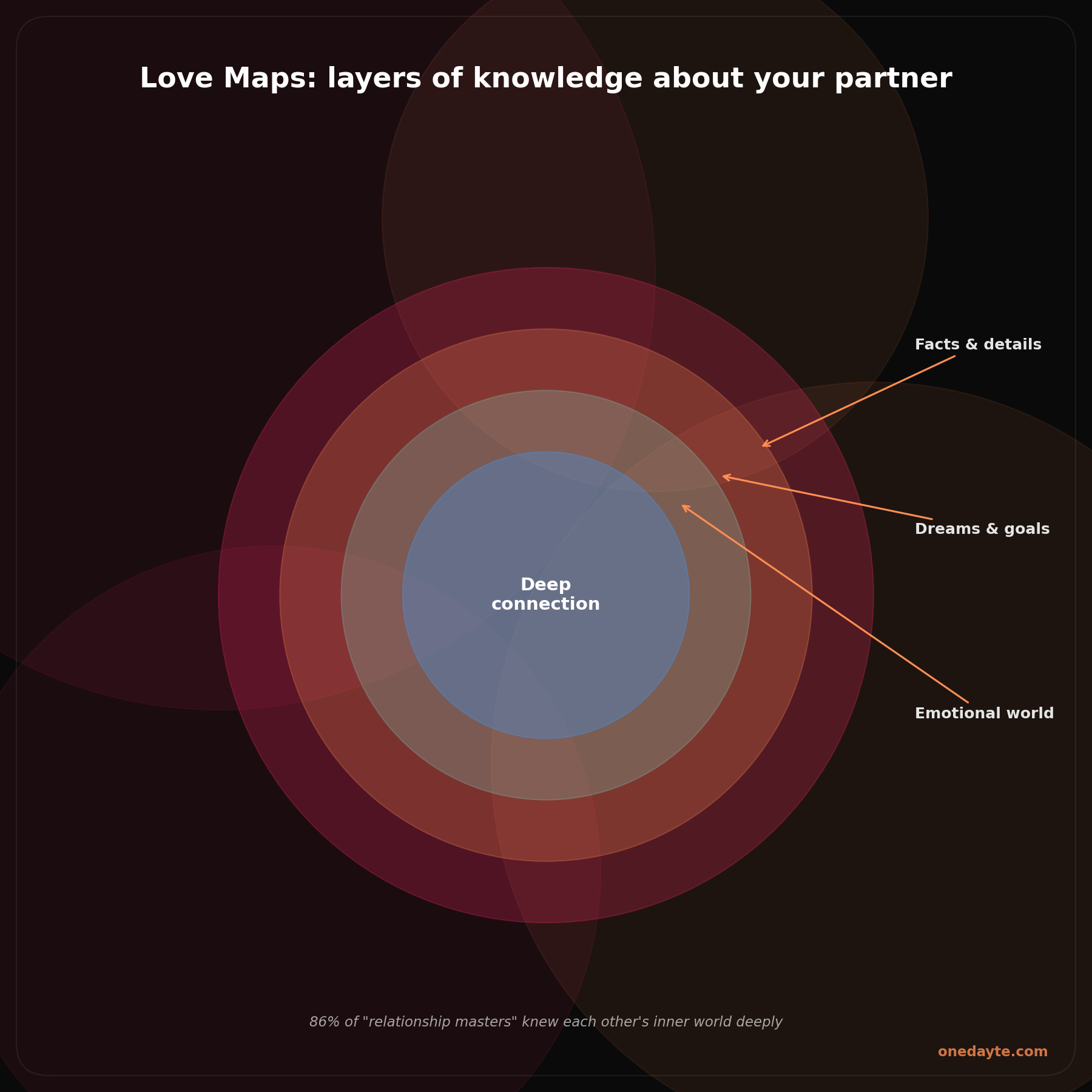
What are Love Maps?
A Love Map is the sum of what you know about your partner's dreams, fears, values, stressors, and daily experiences. It goes beyond surface-level knowledge. It's about the things that truly drive someone, the things that hurt, the things that give energy. The name of a colleague your partner has a difficult relationship with. The book that changed her perspective. The insecurity he never says out loud.
Gottman discovered that couples who regularly update each other's Love Maps are more resilient against stress, conflicts, and life changes. The explanation is that this emotional knowledge functions as a buffer. When life gets difficult (a move, a job loss, a sick family member), you have a reservoir of understanding to fall back on. Without that buffer, every problem feels like an attack on the relationship instead of a challenge you face together.
How do you build Love Maps?
You build Love Maps by asking open questions and genuinely listening to the answer. Not the standard questions about work and hobbies, but questions that reveal the inner world. 'What's a memory that always makes you happy when you think back on it?' 'What are you most worried about right now?' 'What does your ideal Thursday evening look like — not the weekend, but an ordinary weeknight?'
Equally important is what Gottman calls turning toward. Every time your partner shares something, makes a remark, sighs, or gives an emotional signal, that's what he calls a bid for connection: an invitation to connect. Do you respond to it (turning toward) or ignore it (turning away)?
The numbers are impressive. Gottman discovered that couples who were still together after six years turned toward each other in 86 percent of such bids. Couples who divorced did so in only 33 percent. The difference isn't in grand romantic gestures, but in thousands of small moments of attention.
Love Maps and dating: why first conversations matter
The quality of the first conversation determines whether a real connection is formed. A 'hey, how are you?' rarely leads to the emotional connection needed to sustain interest. It's a closed question that elicits a closed answer, and then you're already stuck.
Love Maps-style questions work differently. They invite stories, vulnerability, genuine exchange. Arthur Aron's research (1997) confirms this: his famous 36 questions experiment showed that gradually deepening personal questions create more connection in 45 minutes than weeks of superficial contact.
How Onedayte facilitates Love Maps
In the Guided Connection (Phase 6 of the Onedayte process), both partners receive the same set of 5 questions that they answer in turns. The questions are designed to facilitate vulnerability without being too heavy for a first interaction: 'What's something few people know about you, but that you'd be willing to share?' 'What do you value most in your best friend?'
After this round, the free chat opens, supplemented with subtle conversation suggestions based on each other's answers. 'Julie mentioned that she loves cooking. Ask her about her favourite dish to make.' These suggestions are based on the turning toward principle: every answer from the partner is an emotional signal that wants to be acknowledged.
Source: Gottman & Silver (1999)