First date tips: what science says about making a good first impression
Onedayte Redactie
Expert at Onedayte
Forget the tricks. Forget the opening lines. Forget the strategic waiting time before texting back. If you really want to know how to have a good first date, don't look at dating coaches on Instagram but at what the research says. And the research says something different than you'd expect.
Most date tips you find online are based on personal experience and intuition. 'Be mysterious.' 'Let him come after you.' 'Play hard to get.' This kind of advice plays on the dopamine system and creates short-term tension, but it lays no foundation for a real connection. And a real connection is what you need if you're looking for more than a nice evening.
Ask real questions
Psychologist Arthur Aron and colleagues published their famous study in 1997 in the Personality and Social Psychology Bulletin. They had two strangers answer gradually deepening personal questions. After 45 minutes, the feeling of connection was stronger than in couples who had chatted superficially for weeks. One of the couples married six months later.
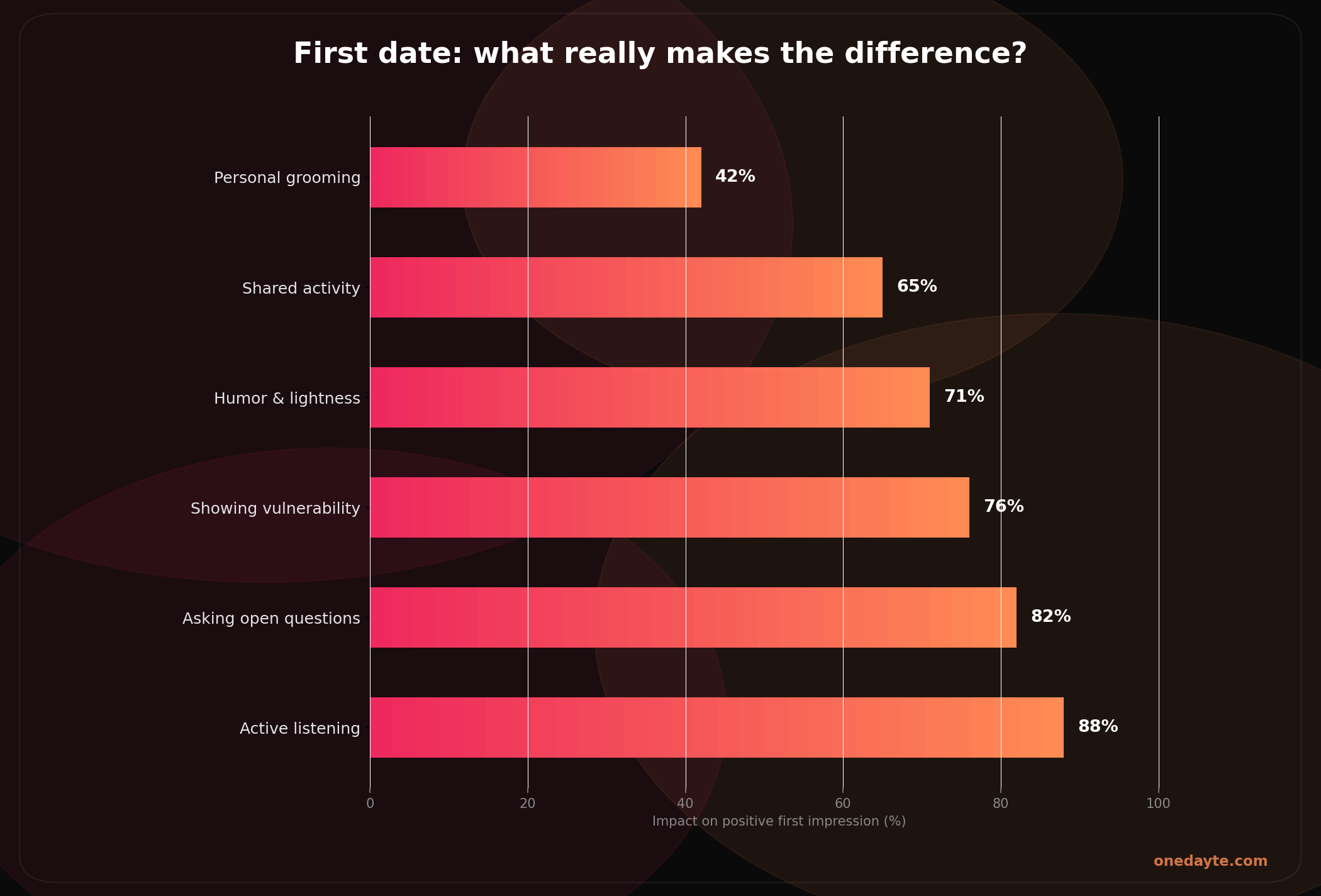
The lesson is not that you should ask all 36 questions on a first date. The lesson is that personal, open questions that invite stories and self-reflection create a deeper connection than small talk. Not 'What do you do for work?' but 'What do you enjoy most about what you do?' Not 'Do you have brothers or sisters?' but 'Who in your life has shaped you the most?'
Listen actively
Active listening is more than being silent while the other person talks. It is repeating what the other person says in your own words ('So if I understand correctly...'). It is asking follow-up questions that show you've really listened. It is responding to the emotion behind the words, not just the facts.
Gottman discovered that turning toward (responding to emotional signals) is the strongest predictor of relationship stability. On a first date, that already begins. If your date tells you about a difficult week and you respond with 'That sounds tough. How did you experience that?', that is a turning toward. If you respond with 'I had a busy week too', that is a turning away. The difference is subtle but the effect is measurable.
A practical tip that comes directly from the research: start your date with an activity instead of a conversation. Walking together, getting coffee together, visiting a market together. Movement lowers cortisol (the stress hormone) and increases endorphins, which reduces nerves and increases openness. Moreover, the surroundings offer natural conversation starters that take away the pressure of silences. It doesn't have to be spectacular. Sometimes a walk through the park is the best setting for a first meeting.
The principle behind this is simple: lower the pressure and increase the openness. That is precisely what the research identifies as the recipe for a good first date.
Be authentic
The research is consistent on this: authenticity is more attractive than a polished image. People feel the difference between someone who is being themselves and someone who is playing a role. That feeling is described as dissonance and it undermines trust, even if the person is objectively interesting.
Being authentic on a first date doesn't mean sharing everything. It means faking nothing. Don't pretend you love running if you hate it. Don't pretend you're relaxed if you're nervous. 'I'm honestly quite nervous' is more authentic and more attractive than a forced coolness.
Applying Love Maps on a first date
Instead of the standard 'what do you do for work?' questions, ask Love Maps questions that open up the inner world without being too heavy for a first meeting: 'What was the best moment of your week?' 'What are you most worried about right now?' 'What do you value most in your best friend?' These are questions that invite vulnerability and self-reflection. They create more connection in ten minutes than an hour of small talk.
Sources: Aron (1997), Gottman Institute, social psychology