Emotional availability: why it is the core of a good relationship
Onedayte Redactie
Expert at Onedayte

Your partner is there, but not really. Physically present, emotionally absent. You talk about your day and notice the attention drifting to a phone screen. You share something vulnerable and receive a rational response ('Maybe you should just...') instead of a warm gesture. It gnaws at you, but you find it hard to put into words. What you are experiencing is called emotional unavailability.
According to the research of Sue Johnson, founder of Emotionally Focused Therapy and author of Hold Me Tight, emotional unavailability is one of the most undermining factors in relationships. Not arguments, not infidelity, not financial stress. The structural absence of emotional responsiveness undermines a relationship faster than any conflict.
What is emotional availability?
"The message of EFT is simple: Forget about learning to argue better. Instead, recognize that you are deeply attached to your partner and that you need emotional connection."
— Sue Johnson, Hold Me Tight, 2008
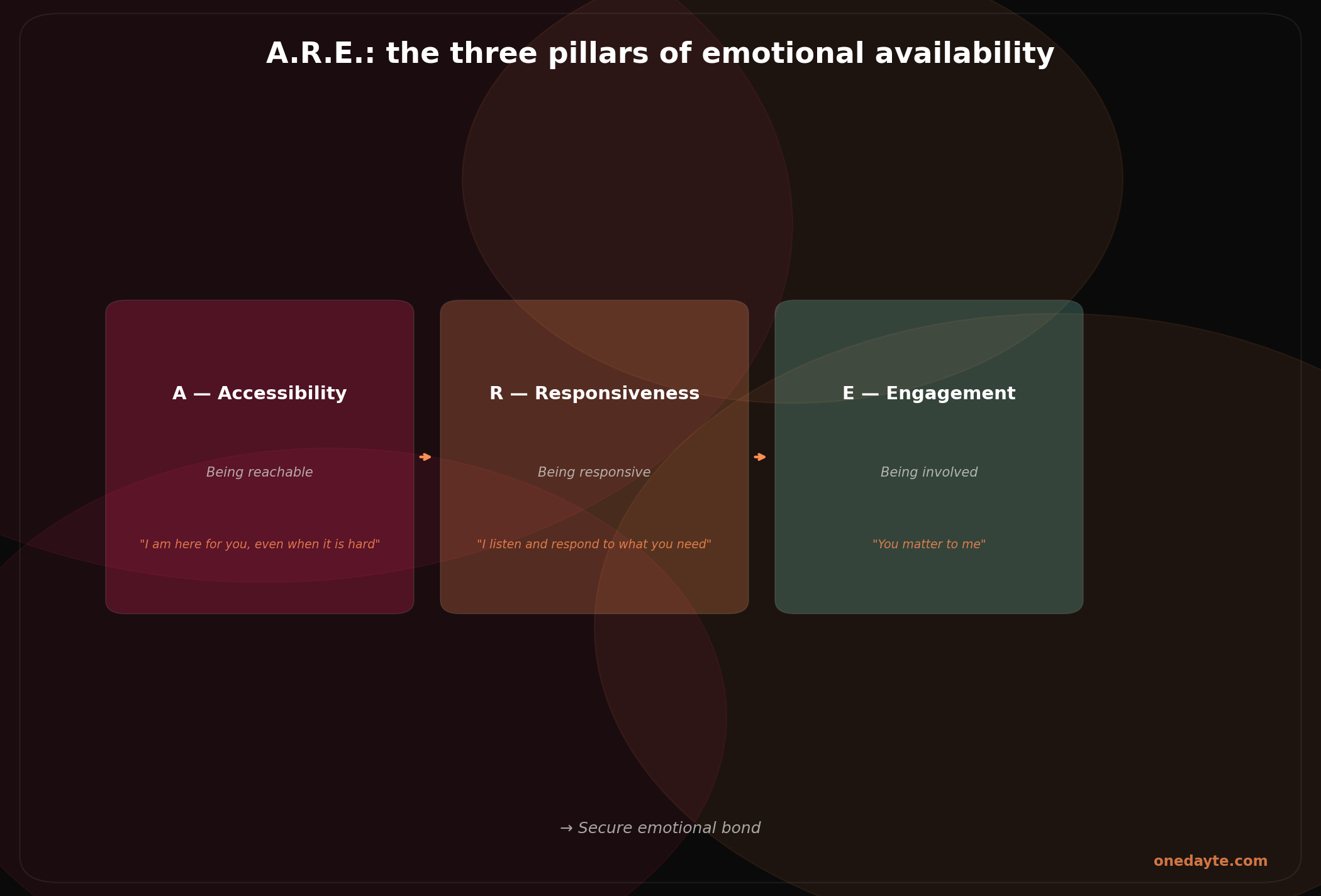
Sue Johnson defines emotional availability through the ARE model: three components that together form the core of every healthy relationship. Accessibility: are you reachable for your partner when they need you? Not just physically, but emotionally. Can you set aside your own activities when your partner is having a difficult moment? Responsiveness: do you respond to your partner's emotional signals? Not with advice or solutions, but with acknowledgement and empathy. 'I can see you're having a hard time' is sometimes more valuable than 'Maybe you should try this.' Engagement: are you involved in your partner's emotional life? Do you ask questions, show interest, actively invest in understanding what occupies the other person?
All three components must be present. Someone who is physically available but does not respond emotionally is just as unavailable as someone who isn't there. A partner who listens but never asks follow-up questions lacks the engagement component. A partner who is only available when it suits them lacks the accessibility.
How do you recognise emotional unavailability?
The signals are often subtle. Your partner changes the subject as soon as it becomes emotional. Questions about feelings are answered with facts or practical solutions. Physical contact feels mechanical rather than connecting. You feel as though there is a wall as soon as you want to go deeper. Your partner trivialises your emotions: 'Don't be so dramatic', 'It's not that bad', 'You're making a drama out of it.'
Important: emotional unavailability is not always conscious. It is often a learned pattern, rooted in the attachment style from childhood. Someone who grew up with parents who did not acknowledge emotions simply never learned what emotional availability looks like. That doesn't make it less painful for the partner, but it does make it changeable.
The good news is that emotional availability is a skill, not a fixed personality trait. The research of Niels van Santen, EFT couples therapist in the Netherlands, confirms that couples who consciously work on their emotional responsiveness show significant improvement, often within just a few months. It starts with recognising the moments when your partner gives an emotional signal and you choose to respond to it instead of ignoring it.
Emotional availability and matching
At Onedayte, emotional responsiveness accounts for 22 percent of the compatibility score, the highest weight of all dimensions. The Doctor Conversation specifically measures how someone responds to emotional scenarios. Not the words someone chooses (those can be trained), but the pattern behind the response: does someone show empathy or go straight to solutions? Is there openness or defensiveness? These are the data points that determine whether someone is emotionally available.
The research of Niels van Santen, EFT couples therapist in the Netherlands, confirms that measuring this dimension makes the difference between matches that feel superficially good and matches that still work after six months. Emotional availability is not glamorous. It is not the butterfly feeling of a first date. But it is the quiet force that determines whether two people can navigate life together.
Source: Sue Johnson, Emotionally Focused Therapy