Dating app without swiping: why slow dating is the future
Onedayte Redactie
Expert at Onedayte

Swipe left. Swipe right. Swipe left. Swipe right. In less than a second you judge a person based on a photo and a few words. And we call that dating. After years of this pattern, more and more people are realising that something is fundamentally wrong with this approach.
A counter-movement is emerging. More and more daters are consciously choosing platforms that abandon the swipe model. Not out of nostalgia for the time before apps, but from the scientifically supported insight that speed and superficiality do not lead to the connection they seek. That movement has a name: slow dating.
What is slow dating?
Slow dating is a conscious approach to online dating that prioritises quality over quantity. Instead of evaluating hundreds of profiles per day, you receive a limited number of carefully selected matches. Instead of a quick swipe based on a photo, you take time to get to know someone before deciding.
The term is inspired by the slow food movement, which as a reaction to fast food advocates for conscious, local and quality eating. Slow dating applies the same principle to love. The idea is not that dating should be slow or boring, but that you get more when you consume less and invest deeper.
The scientific basis is solid. Barry Schwartz showed that too many options lead to choice paralysis and dissatisfaction. The study by Iyengar and Lepper (2000) confirmed that limited choice leads to higher satisfaction with the final decision. And that the matching algorithms of existing platforms are not scientifically supported.
"The online dating industry has not yet demonstrated that its algorithms are effective."
— Finkel et al., Psychological Science in the Public Interest, 2012
Why less swiping works better
The problem with unlimited swiping is threefold. Firstly, it trains your brain to judge quickly and superficially. You evaluate a person in a quarter of a second based on a photo, while the factors that predict relationship success (attachment style, emotional responsiveness, conflict repair) are invisible on any profile.
Secondly, it creates FOMO: the fear that there is always someone better, just one swipe away. That fear undermines your willingness to invest in a match. Why would you spend three hours on a deep conversation with this person if someone more perfect might be waiting for you?
Thirdly, it leads to dopamine depletion. The swipe model activates the reward system through unpredictable rewards, the same mechanism as slot machines. Over time, the system becomes depleted and the same activity no longer feels rewarding. What remains is an emptiness that some researchers call dating burnout.
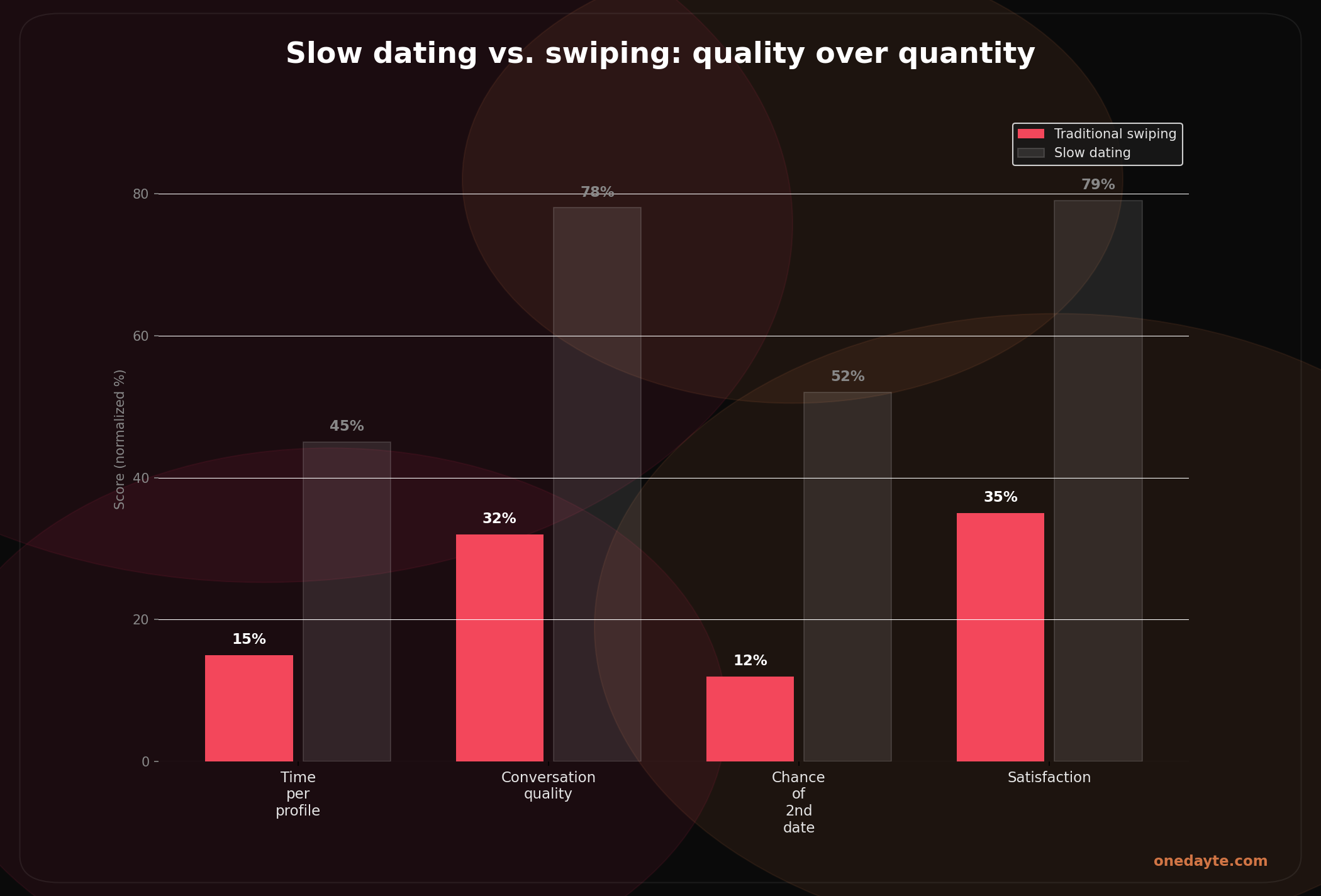
Those who receive 3 carefully selected matches per day demonstrably invest more in each profile. That investment leads to deeper conversations, more genuine connections, and ultimately higher satisfaction with the relationship that results from it.
How Onedayte facilitates slow dating
Onedayte is designed from the ground up as a slow dating platform. No swipe mechanism. A maximum of 3 to 5 matches per day, each with a high compatibility score built from three layers: dealbreaker filtering, attachment compatibility and a weighted compatibility score based on emotional responsiveness, conflict style and shared values.
With each match you choose 'I want to know more' or 'Not for me'. If you choose the first, the Guided Connection starts: a structured conversation based on Love Maps questions that invite vulnerability and genuine exchange. Photos are gradually revealed through the Progressive Reveal system, so you first get to know the person and then the face.
The result is a dating experience that feels fundamentally different from swiping. Instead of consuming, you invest. Instead of judging, you get to know. Instead of feeling drained after a session, you feel enriched by a conversation that was about something meaningful.
Sources: Schwartz (2004), Finkel (2012), Iyengar & Lepper (2000)