Building secure attachment: how to become securely attached
Onedayte Redactie
Expert at Onedayte

When you discover that you are insecurely attached, it can feel like a diagnosis. As if something is fundamentally wrong with how you function in relationships. As if you are programmed to repeat the same mistakes, time and again.
The good news is that this conclusion is incorrect. Attachment styles are changeable. Psychologists call this earned security: the process by which someone who was insecurely attached develops a more secure attachment style through conscious experiences. And the research shows that it is achievable for everyone.
"Earned-secure adults function as effectively in close relationships as their continuously secure counterparts."
— Roisman et al., Child Development, 2002
Can your attachment style really change?
Yes. Longitudinal research by Roisman et al.'s research (2002), published in Child Development, demonstrates that around 25 per cent of people change attachment style over the course of their lives. That is a substantial percentage. It means that your attachment style is not a lifelong sentence, but a pattern that shifts under the influence of experiences.
Important nuance: attachment style is partly genetically determined. Not everyone starts from the same starting point. But the behaviours and beliefs associated with your attachment style are learned in response to your environment. And what has been learned can be adjusted. Not overnight, but gradually, through conscious experiences that teach your nervous system that closeness can be safe.
What is earned security?
Earned security is the process by which someone with an insecure attachment history develops a more secure attachment style through conscious experiences. The term comes from the research of Mary Main, who discovered that some adults with a difficult childhood could still function as securely attached in their adult relationships.
The difference from organically secure attachment (built during childhood through responsive parents) is that earned security is a conscious process. It requires recognising your patterns, understanding where they come from, and practising new behaviour step by step. It is not a quick fix. It is a journey that can take months to years, but that delivers noticeable results at every step.
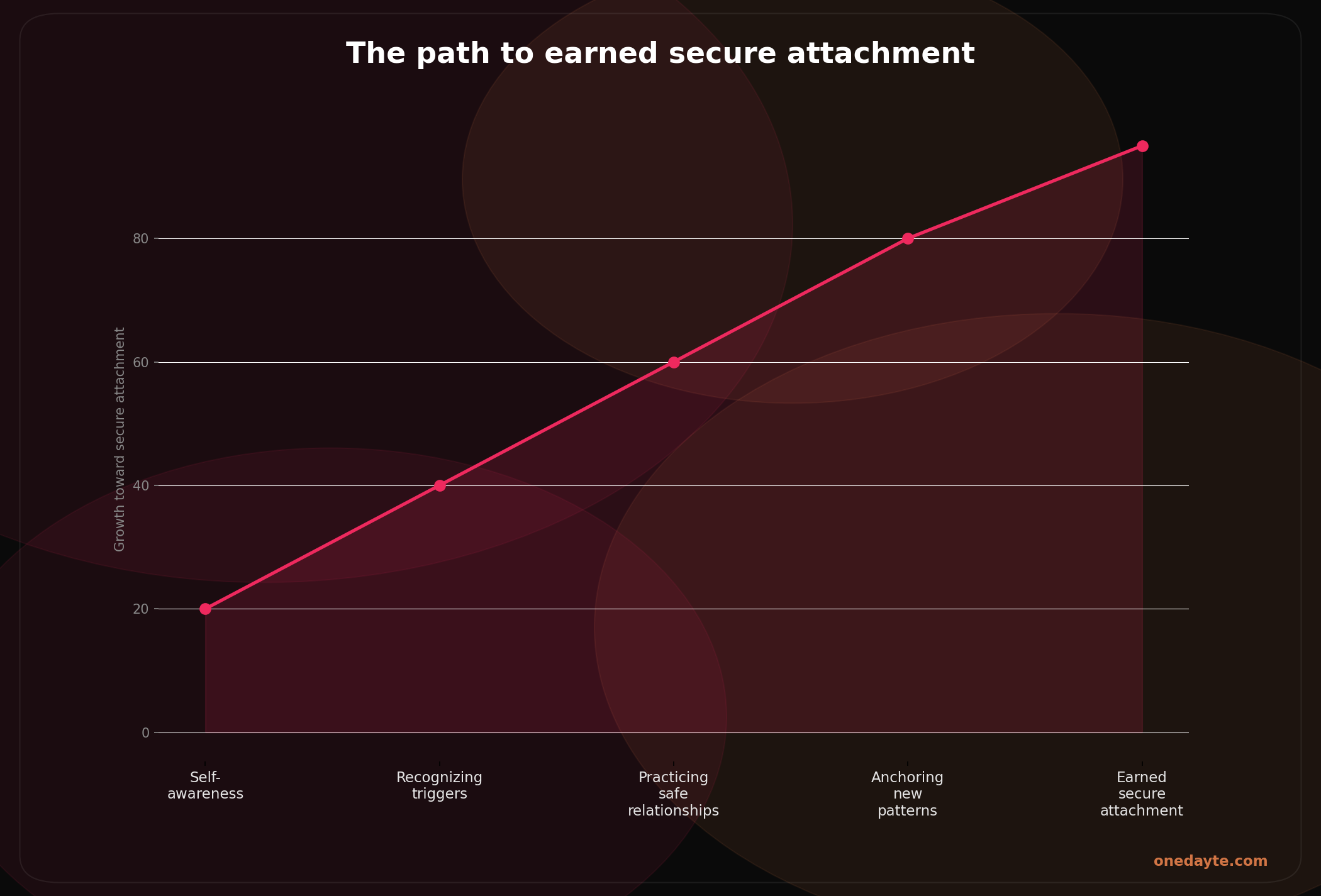
5 steps towards more secure attachment
Know your own pattern. Take a reliable attachment test, such as the one from the Fraley Lab. Recognise your automatic reactions: what do you do when your partner does not respond to a message? What do you feel when someone wants to get close? Awareness is the first and most impactful step.
Seek a secure partner. This sounds like a catch-22 (you are insecurely attached, so how do you choose a secure partner?), but the research is clear: a securely attached partner functions as a corrective emotional experience. By being consistently available, responsive and reliable, your nervous system gradually learns that closeness is safe. That is not something you decide rationally. It is something your body learns through repeated experience.
Work on your inner narrative. Earned security requires processing your childhood experiences. Not to forget them or push them away, but to understand them and place them in a coherent life story. Therapy — particularly Emotionally Focused Therapy or schema therapy — is exceptionally effective for this. Research by Michelle Jonker confirms that this can also begin outside the therapy room, with self-reflection and the right knowledge.
Practise new behaviour. If you are avoidant: practise sharing emotions, even when it feels uncomfortable. Tell your partner that you struggle with closeness. That in itself is already an act of vulnerability that breaks your pattern. If you are anxious: practise tolerating distance without protest behaviour. Reassure yourself with facts instead of interpretations.
Be patient. Attachment patterns have been built over years, during a period of your life when you had no choice. They do not change in weeks. But every small shift counts. Every time you make a secure choice instead of following your automatic reaction, you lay down a new pathway in your brain.
It helps to celebrate small victories. The first time you express your emotion instead of withdrawing. The first time you leave an unanswered message without ruminating. The first time you allow closeness without panicking. These are the moments when your nervous system learns something new. And every new experience of safety makes the next one easier.
Sources: Fraley (2002), Mikulincer & Shaver (2007)