Avoidant attachment style: recognising and breaking through it
Onedayte Redactie
Expert at Onedayte

Your partner wants to talk about your relationship and you feel the walls going up. Not literally, but something inside you shuts down. You need space, independence, a moment of not having to do anything. Intimacy does not feel like warmth but like pressure. And the strangest thing is: you know you love this person. But as soon as it gets close, you want to run away.
This is the avoidant attachment style. Approximately 25 per cent of adults recognise themselves in this, though most would not put it that way. They prefer to say: 'I'm just independent.' Or: 'I don't really need constant contact.' Those phrases are not necessarily untrue, but they mask a deeper pattern.
How avoidant attachment develops
Avoidant attachment develops when your caregivers were emotionally distant or dismissive. Not necessarily cold or mean, but structurally unresponsive to your emotional needs. As a child, you learned that crying did not lead to comfort, that showing vulnerability was not met with a response, that you were better off solving things on your own. You adapted by suppressing your emotional needs. Independence became your survival strategy.
Mikulincer and Shaver (2007) describe in Attachment in Adulthood how this strategy creates a deactivating attachment system. Instead of activating your attachment system when you feel unsafe (as anxiously attached people do), you switch it off. You suppress the need for closeness. You convince yourself that you do not need anyone. And that works, up to a point. Because beneath that layer of independence lies the same human need for connection that everyone has. You have simply learned to hide it.
"Avoidant individuals learn to suppress or deny attachment needs and to rely on themselves as their own source of comfort and security."
— Mikulincer & Shaver, Attachment in Adulthood, 2007
Characteristics in relationships and when dating
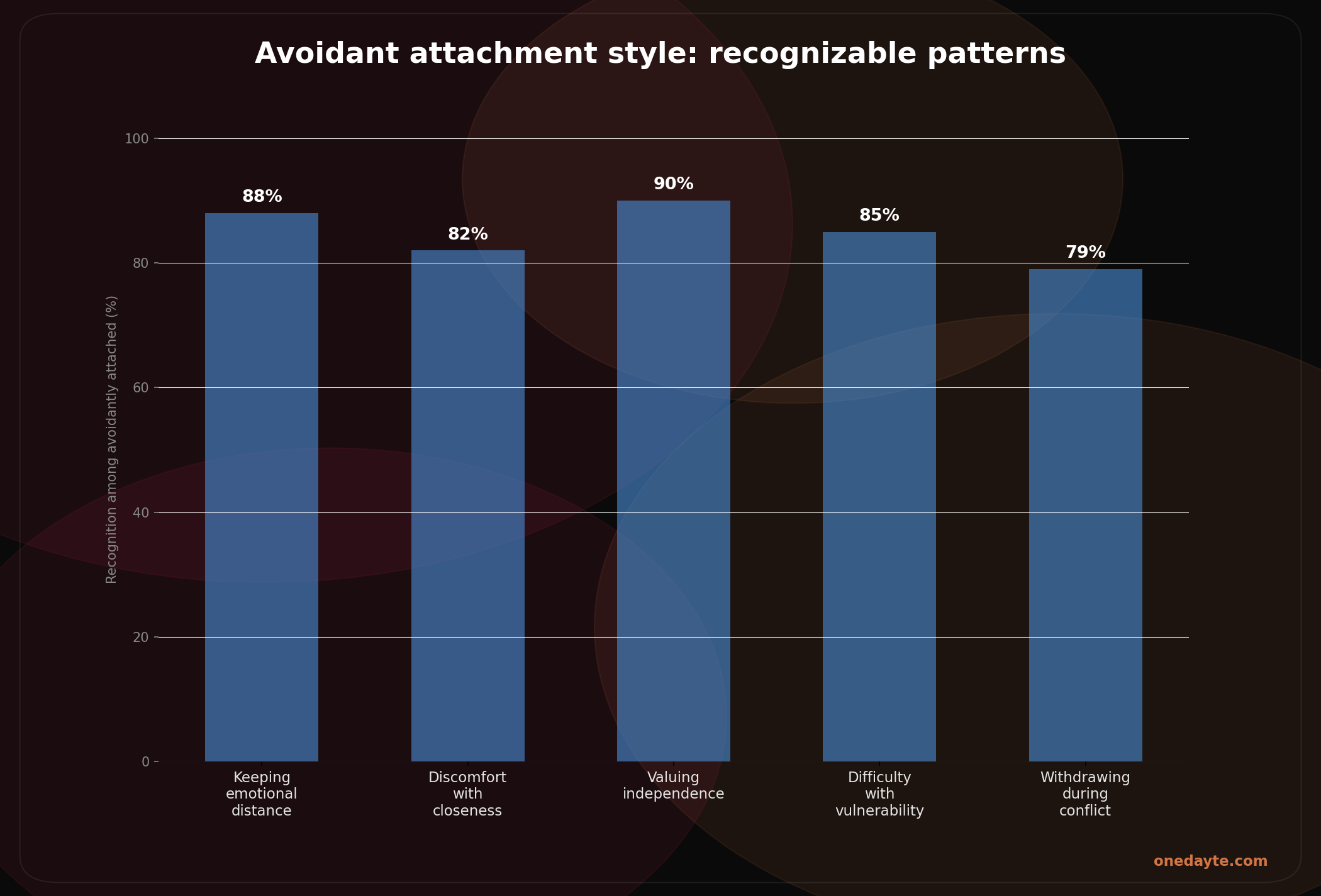
The most recognisable characteristic is discomfort with emotional depth. Conversations about feelings feel awkward. When your partner asks what you feel, the first answer is often 'fine' or 'I don't know'. Not because you feel nothing, but because access to those feelings has been shut off through years of suppression.
On dating apps, this manifests in a specific pattern. You swipe broadly but invest little. Conversations remain superficial. As soon as things start to get serious (the other person suggests calling, meeting up, becoming exclusive), you activate what psychologists call deactivating strategies. You idealise an ex ('They were actually much better suited'). You look for faults in the current match ('She uses too many exclamation marks'). You withdraw without explanation.
In existing relationships, the pattern is similar. The tendency to approach problems rationally rather than emotionally. A need for a lot of personal space that your partner experiences as distance. Difficulty naming what you need, because you have learned that you should not need anything. And a recurring feeling that you would be happier alone — which surfaces precisely at the moment the relationship deepens.
Why avoidant attachment is so difficult to recognise in yourself
The insidious thing about avoidant attachment is that from the outside it looks like self-sufficiency. In a culture that celebrates independence, avoidant attachment behaviour is often rewarded. You are the person who does not 'need too much', who is 'not clingy', who 'does their own thing'. It sometimes takes years before someone recognises that this independence is not only a strength, but also a wall that blocks connection.
The Fraley Lab has developed validated measurement instruments that measure the difference between healthy independence and avoidant attachment. The ECR-R (Experiences in Close Relationships Revised) specifically measures the avoidance dimension: not whether you are independent, but whether you become uncomfortable with emotional closeness. That distinction is fundamental.
What you can do about it
Recognise your deactivating strategies for what they are: defence mechanisms from your childhood that are no longer needed in adult relationships. Every time you idealise an ex at the moment your current relationship deepens, that is your attachment system trying to pull the emergency brake. It is not intuition you should follow. It is a pattern you can see through.
Practise naming emotions, even when it feels awkward. Start small. 'I notice I feel uncomfortable when we talk about this.' That is already vulnerability. It does not have to be an emotional monologue straight away. Every time you name a feeling instead of pushing it away, you lay down a new pathway in your brain.
Choose a partner who has patience but also sets boundaries. A partner who gives you space without letting you go. Who understands that your withdrawn behaviour is not rejection, but a protective reflex. And who at the same time honestly says: 'I need more than this.' That combination of patience and honesty is what research identifies as most conducive to growth in avoidantly attached people.
Sources: Mikulincer & Shaver (2007), Bartholomew & Horowitz (1991)